Part 1: Foundations of the War Horse
"In all equestrian exercises, the two most important things are, first, never to get angry, and second, never to be frightened." — Xenophon, On Horsemanship [1]
Welcome to the first installment of The War Horse’s Path, a series dedicated to uncovering the martial origins of modern dressage. Before the polished performances of the Olympic arena, these movements were a matter of survival, honed on the battlefield to create a responsive, agile, and reliable war horse.
Today, we begin where every rider and every war horse in history began: with the basics. The Introductory and Training Levels of modern dressage are the direct descendants of the foundational exercises used by cavalry across centuries to prepare their mounts for the chaos of combat.
The Purpose of the Tests
Before we dive into the movements, it’s important to understand what the judges are looking for at these levels. According to the United States Dressage Federation (USDF) and United States Equestrian Federation (USEF), each level has a specific purpose:
Introductory Level: “To introduce the rider and/or horse to the sport of dressage, confirming that they are beginning to develop an understanding of correct dressage basics. The horse should be ridden freely forward in a steady tempo and clear rhythm, accepting contact with the bit. An understanding of test accuracy and geometry should be demonstrated.[2]”
The introduction to the 20-meter circle
Training Level: “To confirm that the horse demonstrates correct basics, by showing suppleness both laterally and longitudinally, moving freely forward in a clear rhythm with a steady tempo, and readily accepting contact with the bit. Correct geometry and lines of travel should be shown.[2]”
Introduction to the changing of bend on a shallow loop
Review the Tests: You can find the current USEF/USDF Dressage Test sheets and their detailed purpose statements here: USDF Dressage Test & Forms
The Remount’s First Lessons: Forging the War Horse
In military terms, a new horse was a "remount," and its training was a systematic process of desensitization and conditioning. The goal was not to create a flashy show horse, but a dependable partner that would hold its nerve amidst the clash of steel, the roar of cannons, and the frantic movements of a cavalry charge. The training philosophy of the German cavalry, outlined in the Heeresdienstvorschrift H.Dv. 1912 ‘army regulations’ manual, would later form the basis of the modern Dressage Training Scale [3]. The first and most crucial elements of this scale are rhythm and relaxation.
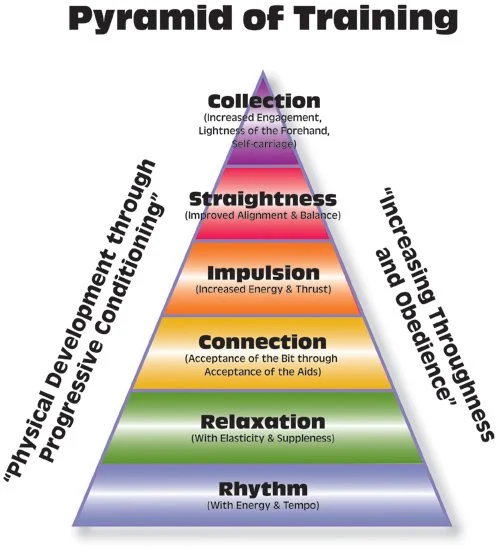
Figure A. The Horse Magazine. (2026). Dressage training pyramid [Digital image]. https://www.horsemagazine.com/thm/2025/02/10174/dressage-training-pyramid/
You can find more detailed information on the pyramid here: Pyramid of Training
A horse that is tense cannot learn, and a horse without a steady rhythm cannot be controlled in a large formation. Early military training focused on long, straight lines and, most importantly, massive circles and serpentines. These figures were not for show; they were a practical tool for teaching a horse to move calmly and obediently within a group, preventing the natural instinct to bolt or herd-up in a panic.
Rhythm (With Energy & Tempo):
Military Purpose: To ensure the entire cavalry unit could move as one, maintaining speed and formation.
Modern Dressage Equivalent: The fundamental requirement for all gaits, characterized by the regularity of the steps and the tempo.
Relaxation (With Elasticity & Suppleness):
Military Purpose: To keep the horse responsive to the rider's aids, even when surrounded by noise and fear.
Modern Dressage Equivalent: A state of physical and mental calm where the horse's muscles are supple and its back is swinging. The horse learns to accept the rider’s influence without becoming tense.
Circles:
Military Purpose: To practice group maneuvers and to keep the unit a moving, difficult target.
Modern Dressage Equivalent: A training tool used to develop the horse's lateral suppleness, balance, and the ability to bend uniformly through its body.
The Cantabrian Circle: A Masterclass in Harassment
One of the most effective historical applications of these basic figures was the Cantabrian Circle, a tactic perfected by the cavalry of ancient Iberia [3]. Riders would form a large, continuously moving circle, riding toward the enemy to throw javelins or fire arrows before wheeling away under the protection of the riders behind them. This created a constant barrage of missile fire from a target that was almost impossible to attack. It required immense control, a steady rhythm, and a horse that could maintain its path without panicking—the very skills we develop in today's Introductory Level tests.
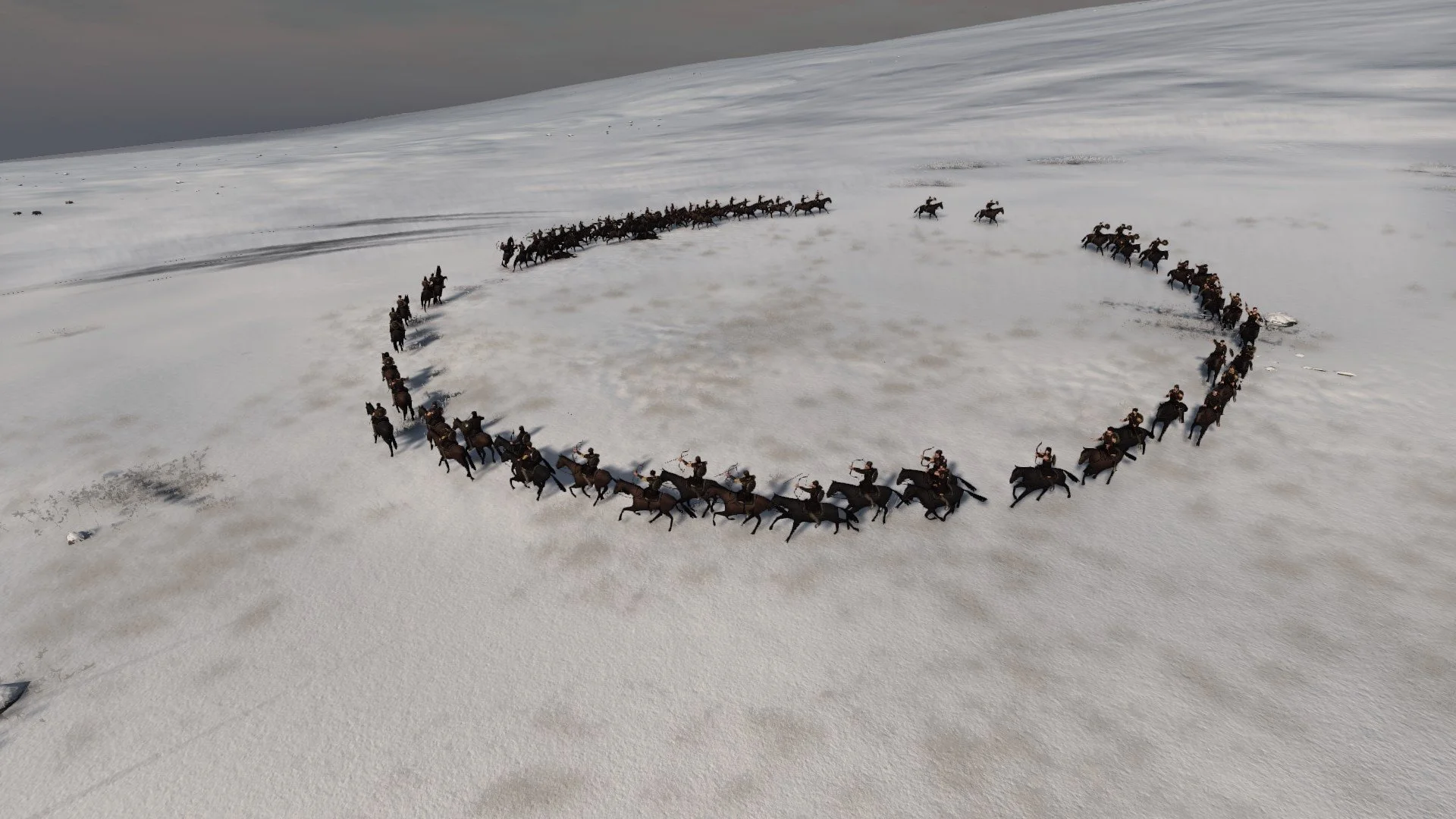
Figure B. Horses maneuver in a tight circle during cavalry exercises at Fort Ethan Allen, Burlington, Vermont, ca. 1917–1934. Photo by Leslie Jones. Courtesy of the Boston Public Library, Leslie Jones Collection.
The Gymnastic Benefits of the 20-meter Circle: Building a Stronger, More Supple Mount
While the military purpose was practical, the gymnastic benefits of these simple exercises are profound. Riding a horse on a correct 20-meter circle or a single loop is one of the first steps in developing lateral suppleness. As the horse bends its body from poll to tail, the muscles on the outside of its body are gently stretched, while the muscles on the inside are asked to contract. This simple action is the beginning of creating a more athletic and ambidextrous horse.
Furthermore, consistent work on large circles and frequent, smooth transitions between gaits (e.g., trot to walk, walk to trot) begin to engage the horse's hindquarters. Each upward and downward transition encourages the horse to step further under its body with its hind legs, which is the first step toward collection and the powerful, uphill balance required for the more advanced movements we will explore later in this series.
The Responsive Transition: A good transition in riding is a smooth shift, much like a gear change, rather than an abrupt stop. To prepare for a downward transition, such as from trot to walk, deepen your seat, close your legs to maintain the horse's energy, and gently resist forward motion with your core and a half-halt on the outside rein. The goal is for your horse to step smoothly into a forward, balanced walk without losing its rhythm.
How to Do The 20-meter Circle: Mastering the Foundations
Whether you are a military commander or a modern dressage enthusiast, the goal is the same: a horse that is balanced, obedient, and on your aids.
The Perfect Circle: There are multiple ways to perfect the 20-meter circle. Listed below are a few options:
One option when riding a 20-meter circle, visualize a perfect circle on the ground. Use four points on the circle (at 12, 3, 6, and 9 o'clock) to guide your path. Your inside leg at the girth asks the horse to bend, your outside leg slightly behind the girth prevents the haunches from swinging out, and your outside rein maintains the pace and size of the circle.
Counting strides is another incredibly effective exercise to ensure consistency in rhythm and size throughout the circle. It helps the rider develop a "metronome" in their head, ensuring the horse maintains its tempo from start to finish.
-Trot: Aim for 24-28 strides for a full 20-meter circle, which breaks down to roughly 6-7 strides per quarter-circle. For average-strided horses, 22-24 strides is also a common benchmark.
-Canter: Aim for roughly 16-20 strides for the full circle, or 4-5 strides per quarter-circle. This will vary depending on the horse's size and stride length.
A third way to execute a precise 20-meter circle, whether at the center or ends of the arena, is to visualize it as a diamond connecting four key points. For a right-rein circle initiated at C, using Image C as a guide follow these steps:
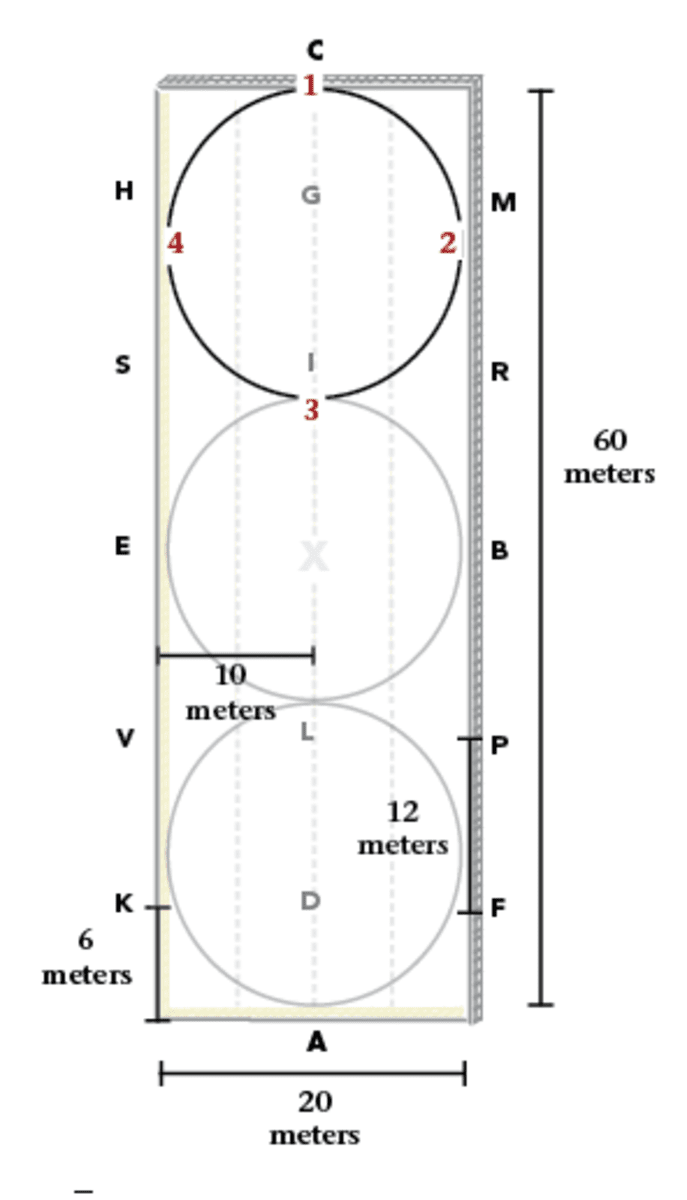
Start at C (Point 1).
Arc to the Track (Point 2): Ride a gentle diagonal line, aiming to meet the track 10 meters from the corner, specifically 4 meters past M and 8 meters before R.
Cross the Centerline (Point 3): Continue on a diagonal line to a point 20 meters down the centerline from C, which is 2 meters past I.
Arc back to the Track (Point 4): Maintain your diagonal, targeting a point on the track 8 meters past S, ensuring you arrive 4 meters from the corner letter H.
I Complete the Circle: Return to your starting point at C.
Image C. Diagram of a standard 20m x 60m dressage arena showing the geometry for three 20-meter circles. Image courtesy of Dressage Today.
For more information on ‘how to’ do a 20 meter circle check out this article on the USDF website: Lesson Topic: Circles
Movement Spotlight: The Single Loop
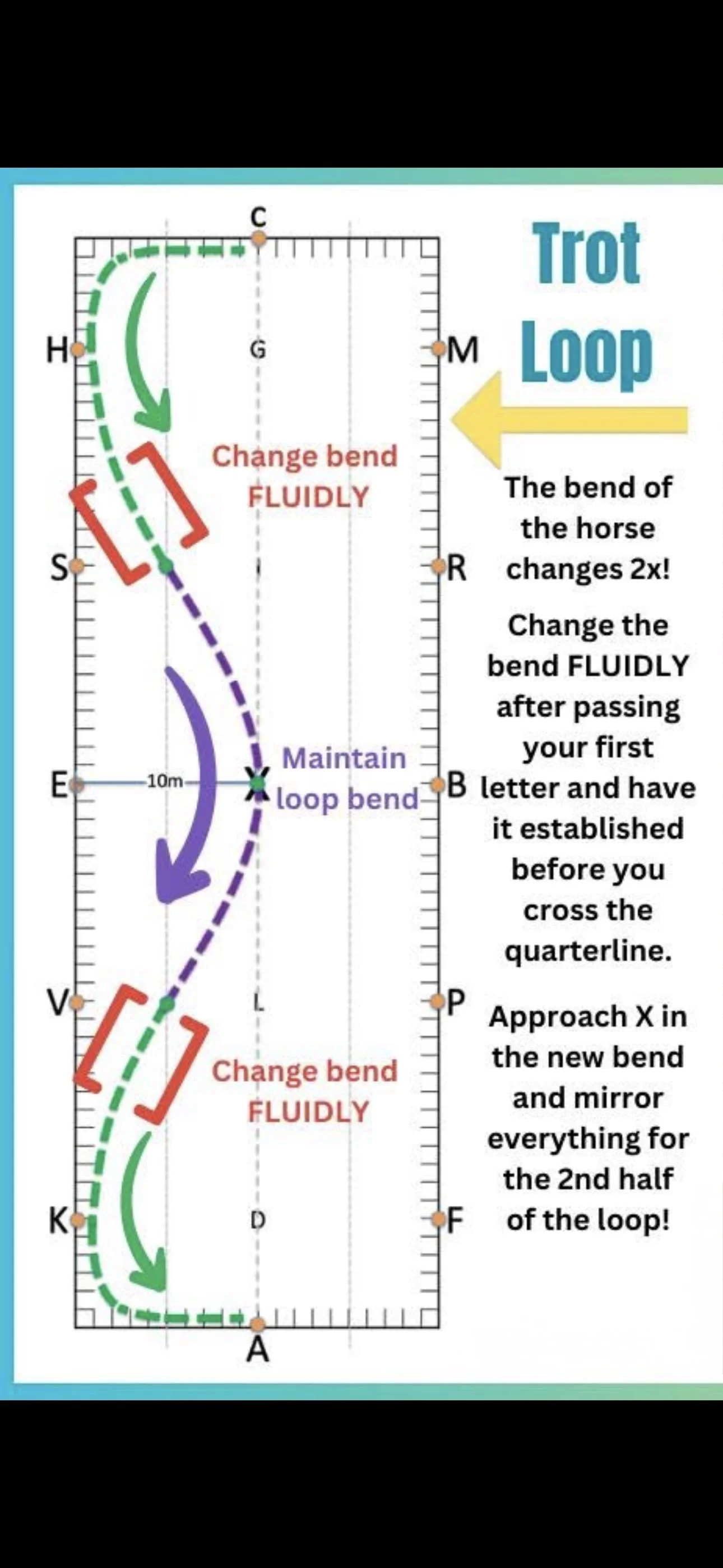
In Training Level, riders are introduced to the Single Loop, a movement where the horse leaves the track at a letter, curves 5 to 10 meters away from the rail, and returns to the track at another letter.
The Military Purpose: Historically, the single loop was a foundational exercise for navigating around obstacles—such as a fallen horse, a wagon, or a tree—without breaking the line of march. It also taught the horse to change its bend and balance smoothly, which was essential for shifting a unit’s position during a flanking maneuver. It is the precursor to the more complex serpentines used to navigate tight terrain.
How to Do It: To ride a correct single loop, start by establishing a steady trot on the long side. As you reach the starting letter (e.g., F), use your inside leg and outside rein to guide the horse away from the rail in a smooth, shallow curve. At the apex of the loop (e.g., X), the horse should be straight for a moment before you use your new "inside" aids to curve back toward the track. The key is to maintain a consistent rhythm and a smooth, uniform bend in both directions.
Image D. Comparison of the bend requirements for the trot loop and canter loop in dressage. Image courtesy of The Refined Rider (therefinedrider.com).
A Note on Gaits
You may notice we haven't spent much time discussing the differences between the working, medium, and collected gaits. Because the "how-to" of the walk, trot, and canter is such a deep and vital topic, we will be dedicating a completely separate series to the mechanics of the gaits. For now, our focus remains on the movements and how they served the war horse on the battlefield.
Conclusion
At Moonlight Equestrian Center, our training philosophy remains firmly rooted in the Dressage Training Pyramid, ensuring that every horse and rider develops a solid foundation of rhythm, relaxation, and connection before progressing. In this first installment, I have aimed to demystify the 'why' and 'how' of our foundational figures—uncovering their martial origins, detailing their precise execution, and highlighting the profound gymnastic benefits they offer your mount.
With these basics mastered, you are prepared for the more sophisticated demands of First and Second Level. As a sneak peek into our next article, we'll explore how the cavalry utilized lateral work not for show, but for survival. Consider how the leg-yield was used to move a horse away from a threat, how the shoulder-in helped a rider navigate narrow mountain passes or keep a horse's focus in the chaos of a charge, and how travers (haunches-in) allowed for the precise positioning needed to strike an opponent. These movements are the next steps in our journey, transforming the responsive remount into a truly agile and battle-ready partner.
References
[1] Xenophon. On Horsemanship. Translated by Morris H. Morgan, The J. A. Allen & Co. Ltd, 1962.
[2] United States Dressage Federation, and United States Equestrian Federation. “Forms & Documents.” Forms & Documents, United States Dressage Federation, 2022, https://www.usdf.org/downloads/forms/index.asp?TypePass=Tests. Accessed 27 February 2026.
[3] German National Equestrian Federation. The Principles of Riding: The Official Handbook of the German National Equestrian Federation. Kenilworth Press, 2012.
[4] USEF. Rule Book: Dressage Division. United States Equestrian Federation, 2024.